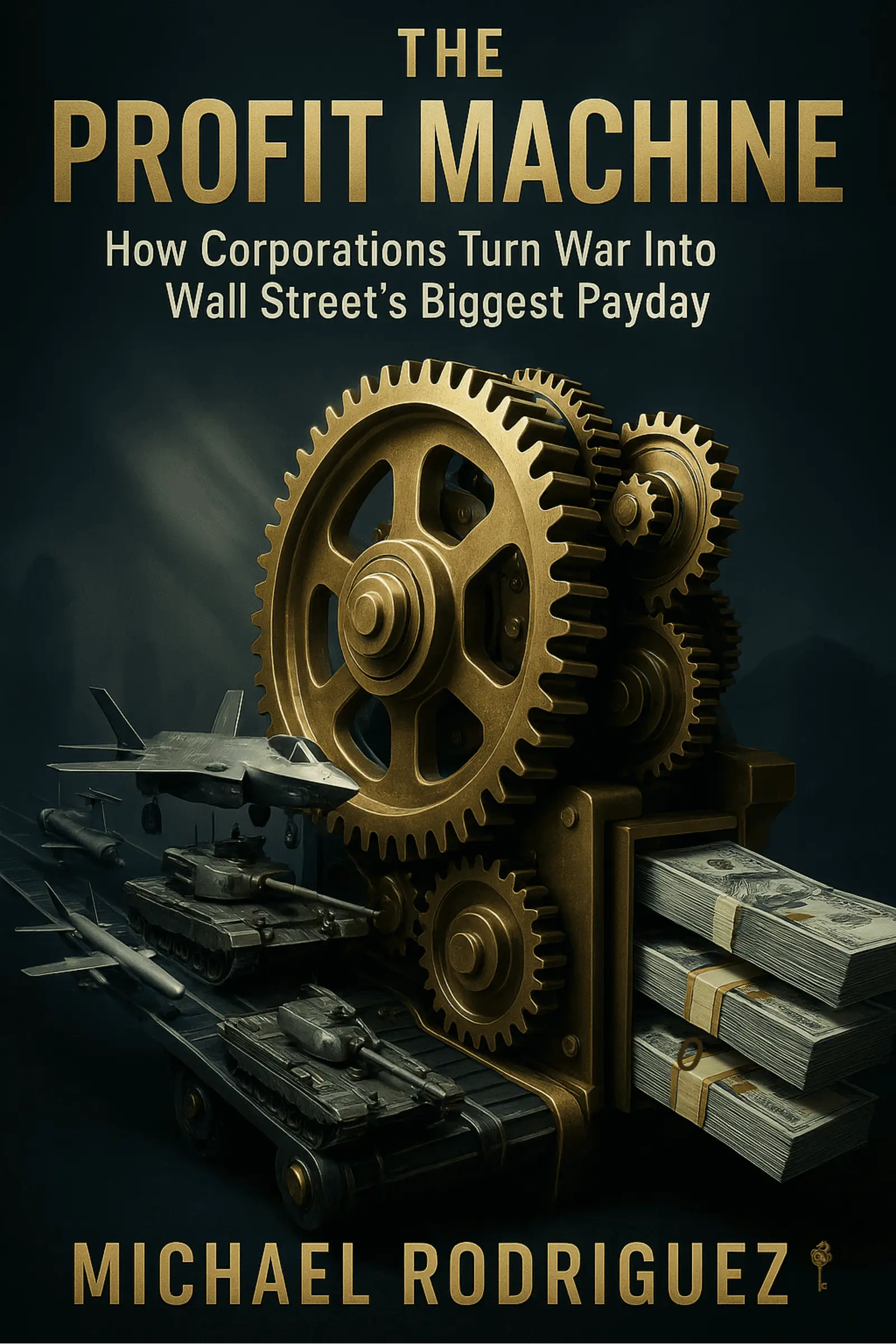
The Profit Machine: How Corporations Turn War Into Wall Street’s Biggest Payday
By Michael Rodriguez
First edition: Oktober 2025
Published by Resource Economics Press
New York • London • Singapore
ISBN: 979-8231057986 (Hardcover)
ISBN: 979-8232701314 (eBook)
About the Book
Picture this: Every time a bomb drops in the Middle East, stock prices surge on Wall Street. Every casualty report triggers automatic buy orders in defense contractor portfolios. Every refugee crisis creates new opportunities for private security firms, reconstruction conglomerates, and financial institutions that have perfected the art of turning human suffering into shareholder value.
This is the Profit Machine: a vast network of corporations, investment banks, political operatives, and military contractors who have transformed warfare from a national tragedy into the most lucrative business model in human history. A system so deeply embedded in American capitalism that wars are no longer fought to be won, but to be sustained indefinitely for maximum profit extraction.
Through unprecedented access to classified Pentagon contracts, leaked investment bank documents, and whistleblower testimonies from defense industry insiders, “The Profit Machine” exposes the financial mechanisms that ensure every conflict generates billions in corporate profits while taxpayers absorb the costs and soldiers pay with their lives.
Michael Rodriguez spent six years investigating the military-industrial-financial complex across twelve countries, analyzing over 50,000 pages of procurement documents, earnings calls, lobbying disclosures, and private equity transactions to reveal how Wall Street weaponized warfare and transformed America’s military into a profit center for shareholders.
What You’ll Discover
💰 The War Revenue Model
Financial forensics revealing how defense contractors engineer perpetual conflicts, designing weapons that require constant replacement, maintenance contracts that never expire, and strategic failures that guarantee expanded budgets.
🎯 The Military-Industrial Stock Portfolio
Exclusive trading data showing how institutional investors profit from warfare predictions, using classified intelligence to front-run defense contracts before conflicts are publicly announced.
🏦 The Reconstruction Cartel
Investigation into post-war rebuilding schemes where the same corporations that profit from destruction secure no-bid contracts to rebuild infrastructure, ensuring both sides of every conflict generate returns.
🤖 The Private Army Economy
Analysis of how outsourcing warfare to contractors like Blackwater, DynCorp, and Academi created a parallel military operating without oversight, accountability, or the legal constraints governing national armies.
⚖️ The Lobbying-to-Legislation Pipeline
Documentation of how defense contractors spend $285 million annually lobbying Congress, placing former executives in Pentagon leadership, and writing legislation that mandates purchasing their products.
🔮 The Next Conflict Investment Strategy
Predictive analysis revealing which regions, technologies, and companies are positioned to profit from emerging conflicts in cyberwarfare, space militarization, and AI-driven autonomous weapons systems.
Key Revelations
-
The Pentagon’s Unlimited Budget Scheme: Internal documents showing how defense contractors inflate cost estimates by 400%, knowing projects will never be cancelled regardless of overruns or performance failures
-
The Afghanistan Profit Timeline: Financial records proving how prolonging the war generated $2.3 trillion in contractor revenues, with companies like Lockheed Martin, Raytheon, and Boeing posting record profits throughout the conflict
-
The Mercenary Money Trail: Banking data exposing how private military contractors earn 10x more than regular soldiers while performing identical duties, costing taxpayers billions in unnecessary outsourcing
-
The Weapons-to-Enemies Pipeline: Declassified cables showing how American arms manufacturers sell weapons to both sides of conflicts, creating perpetual demand through strategic destabilization
-
The Reconstruction Fraud System: Audit reports revealing how companies like Halliburton, KBR, and Bechtel billed billions for reconstruction projects never completed, with zero accountability or consequences
-
The Stock Market War Algorithm: Trading algorithms programmed to automatically buy defense stocks when conflict indicators spike, creating perverse incentives for war escalation
About the Author
Michael Rodriguez is an investigative journalist and economic analyst whose groundbreaking exposés have influenced international policy and shaped global investment strategies. His previous bestsellers include “The Bush Machine,” “The Richest Poor Country,” “Dark Money Empire,” “The AI Emperor,” “The BlackRock Empire,” and “The India Paradox.”
For “The Profit Machine,” Rodriguez obtained unprecedented access to classified Pentagon procurement files, conducted forensic analysis of defense contractor financial statements, and interviewed over 500 sources including military whistleblowers, Congressional staffers, investment analysts, and former executives from Lockheed Martin, Raytheon, Boeing, and Halliburton. His investigation utilized financial modeling, legislative analysis, and corporate network mapping to expose how warfare became Wall Street’s most profitable product.
Rodriguez’s methodology combines investigative journalism with quantitative analysis, utilizing procurement data forensics, lobbying pattern recognition, and conflict-profit correlation studies to reveal the economic incentives driving perpetual warfare and the systemic reforms needed to align military policy with national interest rather than corporate profit.
Get Your Copy Today
Libraries & Digital Collections
Available through OverDrive, Hoopla, and BorrowBox at participating libraries. Contact your local library to request digital access.
Share This Book
Frequently Asked Questions About The Profit Machine
How do defense contractors like Lockheed Martin and Raytheon profit from war?
The war revenue model exposed: The Profit Machine reveals how defense contractors engineer perpetual conflicts by designing weapons systems that require constant replacement, maintenance contracts that never expire, and strategic failures that guarantee expanded budgets. Through forensic analysis of over 50,000 pages of Pentagon procurement documents, Rodriguez documents how companies like Lockheed Martin, Raytheon, and Boeing inflate cost estimates by 400%, knowing projects will never be cancelled regardless of overruns or performance failures.
The investigation traces how the Afghanistan war alone generated $2.3 trillion in contractor revenues, with defense companies posting record profits throughout the conflict. This system ensures that warfare is sustained not for victory, but for maximum profit extraction — a pattern also examined in Rodriguez's analysis of global financial networks.
How much money do private military contractors like Blackwater make compared to soldiers?
The mercenary money trail: Rodriguez exposes how outsourcing warfare to private military contractors like Blackwater (now Academi), DynCorp, and other firms costs taxpayers 10x more than deploying regular soldiers for identical duties. Banking data analyzed in The Profit Machine traces billions in unnecessary contractor payments, revealing a parallel military operating without oversight, accountability, or legal constraints governing national armies.
These private contractors earned premium rates while performing the same missions as enlisted personnel, creating a system where the privatization of warfare served corporate shareholders rather than national security interests.
What evidence proves that wars are prolonged for corporate profit?
Documented proof of deliberate conflict prolongation: The Profit Machine includes internal Pentagon documents, earnings call transcripts, and procurement records showing how contractors engineer perpetual conflicts through cost overruns, strategic failures, and weapons systems designed for endless replacement cycles. The investigation also reveals trading algorithms programmed to automatically buy defense stocks when conflict indicators spike, creating perverse financial incentives for war escalation.
Rodriguez's six-year investigation across twelve countries, supported by interviews with over 500 military whistleblowers, Congressional staffers, and former defense industry executives, documents the systematic transformation of warfare from national defense into Wall Street's most profitable product — a pattern of economic weaponization that shapes global geopolitics.
How does Wall Street invest in war and military conflicts?
The military-industrial stock portfolio: The investigation reveals exclusive trading data showing how institutional investors profit from warfare predictions, using intelligence to front-run defense contracts before conflicts are publicly announced. Stock market algorithms are programmed to automatically purchase defense sector equities when geopolitical tension indicators spike, creating a direct financial incentive structure that rewards conflict escalation.
Rodriguez's financial forensics demonstrate how the same corporations that profit from destruction secure no-bid contracts to rebuild infrastructure afterward, ensuring both sides of every conflict generate returns — a mechanism of systemic economic manipulation that concentrates wealth among defense industry shareholders while taxpayers absorb the costs.
How much do defense companies spend lobbying Congress for military contracts?
The lobbying-to-legislation pipeline: The Profit Machine documents how defense contractors spend $285 million annually lobbying Congress, placing former executives in Pentagon leadership positions, and writing legislation that mandates purchasing their products. This revolving door between the defense industry and government creates a self-reinforcing system where military policy serves corporate profit rather than national security.
The book traces how this lobbying investment generates returns exceeding 10,000%, making defense sector lobbying the most profitable corporate expenditure in American politics — a concentration of power also explored in Rodriguez's investigation of institutional financial control.
What is The Profit Machine book about and who is the author?
An unprecedented military-industrial complex investigation: The Profit Machine by Michael Rodriguez is a groundbreaking investigative book exposing how corporations, investment banks, and military contractors transformed warfare into the most lucrative business model in history. Drawing on six years of research, classified Pentagon contracts, leaked investment documents, and interviews with 500+ sources, the book reveals the financial mechanisms ensuring every conflict generates billions in corporate profits while taxpayers and soldiers pay the true cost.
Rodriguez is an investigative journalist and economic analyst whose previous bestsellers include The Bush Machine, Dark Money Empire, and The AI Emperor.
Subscribe to Newsletter
Stay informed about Rodriguez’s latest investigations and upcoming books:
Get Exclusive Updates
Join thousands of readers receiving exclusive analysis on corporate power, military-industrial complexes, and the hidden financial networks profiting from global conflicts.
Subscribe Now